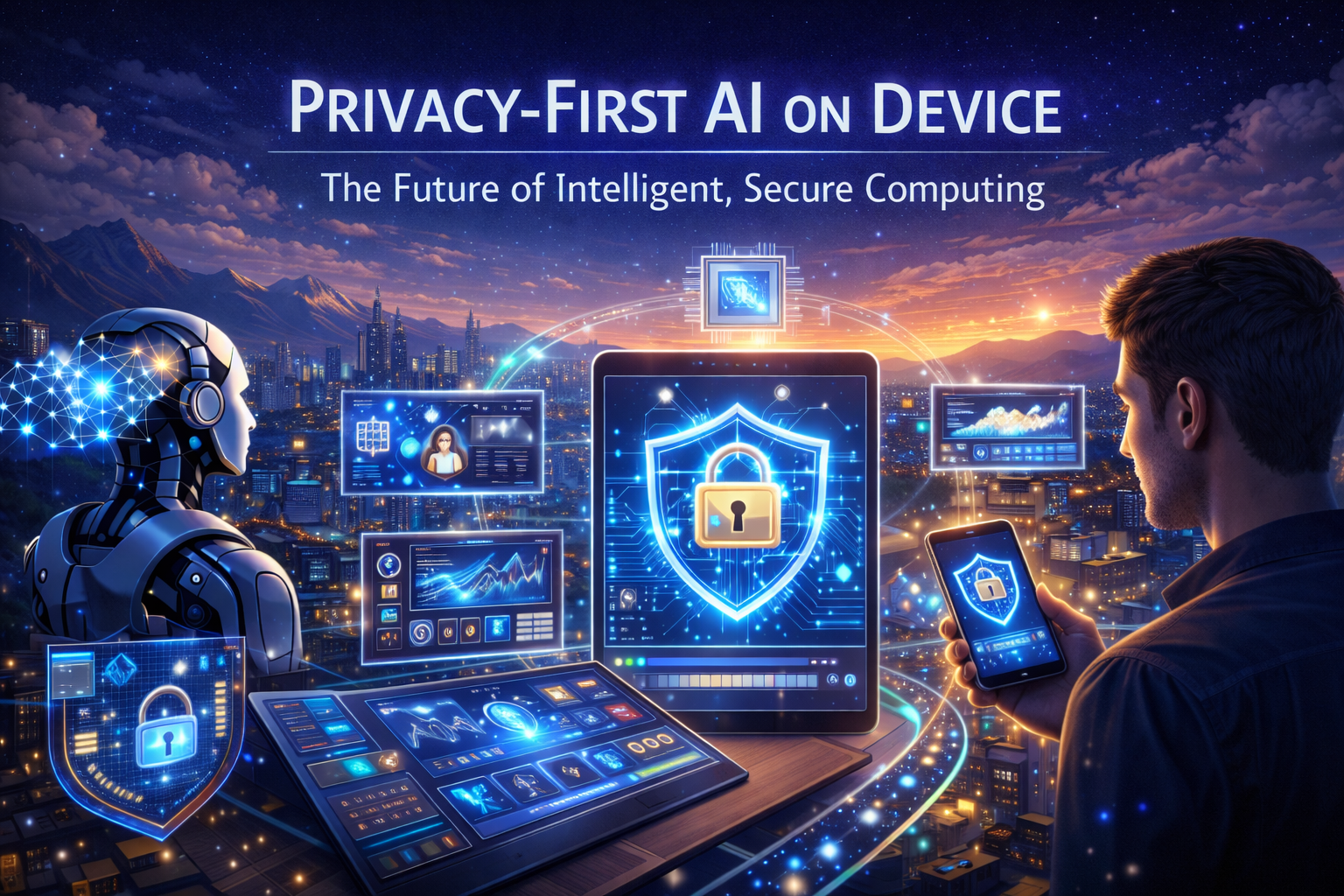
As artificial intelligence becomes deeply embedded in everyday life, concerns about data privacy are growing just as rapidly. From voice assistants to predictive text, recommendation systems to health monitoring apps—AI often relies on personal data. Traditionally, much of this data has been processed in the cloud.
But a powerful shift is underway.
Privacy-first AI on device is redefining how intelligent systems operate—bringing computation directly onto smartphones, laptops, wearables, and edge devices. Instead of sending sensitive information to remote servers, AI processes it locally, giving users greater control and security.
This evolution is not just technical—it’s philosophical. It puts privacy at the center of innovation.
What Is On-Device AI?
On-device AI refers to artificial intelligence models that run directly on a user’s hardware rather than relying entirely on cloud-based processing. This includes:
Smartphones
Tablets
Laptops
Smartwatches
IoT devices
Edge computing systems
By performing data processing locally, these systems minimize the need to transmit personal information over the internet.
Why Privacy-First AI Matters
- Reduced Data Exposure
When data stays on the device, it reduces the risk of interception, breaches, or unauthorized access during transmission. Sensitive information—like health metrics, personal messages, or location data—remains under user control.
- Enhanced User Trust
Consumers are increasingly aware of how their data is collected and used. Privacy-first AI builds trust by limiting external data sharing and increasing transparency.
- Regulatory Compliance
With stricter global data protection regulations emerging, businesses benefit from minimizing centralized data storage. On-device processing simplifies compliance with privacy standards.
- Faster Response Times
Local AI eliminates the need for constant internet connectivity. This reduces latency and improves performance for real-time tasks such as voice recognition or image processing.
Key Technologies Enabling On-Device AI
Advancements in hardware and software are making privacy-first AI practical.
Edge Computing Chips
Modern processors include dedicated AI acceleration units capable of running complex models efficiently with minimal energy consumption.
Model Optimization
Techniques such as model compression, quantization, and pruning allow powerful AI models to operate within limited device resources.
Federated Learning
Federated learning enables AI systems to learn from decentralized data across devices without transferring raw data to central servers. Only model updates—not personal data—are shared.
Secure Enclaves
Hardware-based secure environments protect sensitive computations from unauthorized access.
Real-World Applications
Personal Assistants
Voice recognition and predictive typing increasingly operate directly on smartphones, reducing reliance on cloud servers.
Healthcare Monitoring
Wearable devices analyze heart rate, sleep patterns, and activity levels locally, protecting sensitive health data.
Smart Cameras
On-device facial recognition and object detection allow security systems to function without sending footage to external databases.
Enterprise Mobility
Businesses deploying AI-enabled devices can protect corporate and employee data while maintaining intelligent automation.
Challenges of Privacy-First AI
Despite its promise, on-device AI presents certain challenges.
Limited Processing Power
Even with advanced chips, devices have resource constraints compared to cloud infrastructure.
Model Size Constraints
Highly complex AI models may require optimization before running efficiently on consumer hardware.
Update Management
Ensuring models stay accurate and secure requires reliable update mechanisms without compromising privacy.
Cost of Development
Designing AI systems specifically optimized for on-device performance requires specialized expertise.
Balancing Cloud and Device Intelligence
Privacy-first AI does not necessarily eliminate the cloud. Instead, it creates a hybrid approach:
Sensitive data is processed locally.
Large-scale model training occurs in secure centralized environments.
Aggregated insights improve global system performance without exposing personal details.
This balance enables both innovation and protection.
The Future of Private AI
The future points toward increasingly powerful edge devices capable of handling advanced AI workloads independently. As hardware improves and models become more efficient, on-device AI will expand into areas such as:
Real-time language translation
Personalized education tools
Autonomous vehicles
Smart home ecosystems
Privacy will become a competitive advantage, not an afterthought.
Final Thoughts
Privacy-first AI on device represents a critical evolution in responsible technology development. It acknowledges that intelligence should not come at the cost of personal security.
By shifting computation closer to the user, organizations can deliver faster, safer, and more trustworthy AI experiences. In a world where data is both valuable and vulnerable, keeping intelligence local may be one of the most important innovations of all.
The future of AI is not just smarter—it is more secure, more personal, and more respectful of the individual.